
Last updated on September 15, 2026 by Shannon
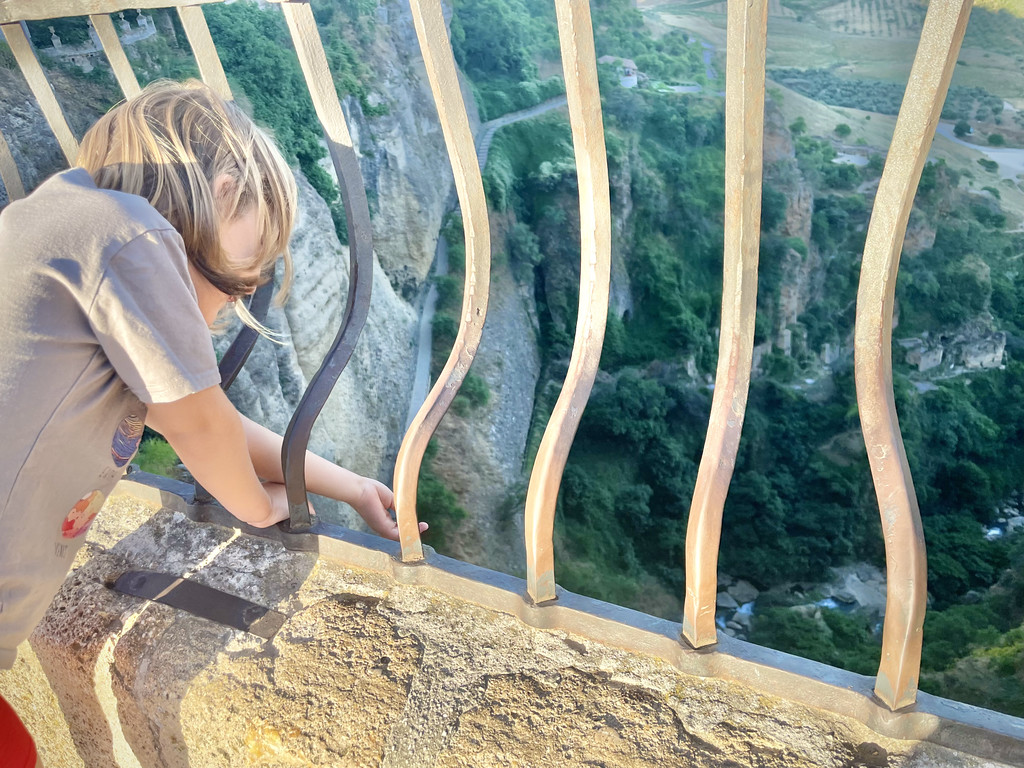
Golden hour hit Ronda’s gorge, El Tajo, hard that first evening—all ochre and burnt orange washing out the green countryside. Birds circled below us riding the wind, pinpricks dancing across all that open space. My son pressed his face into the viewpoint’s curved safety bars, leaning out over the gorge as far as the railing allowed—which, to be clear, is not very far, though my heart hiccuped every time.
We’d eaten dinner back at the apartment, and by the time we wandered outside, the last of the day-trippers had already cleared out. Only the regular Friday evening buzz remained in Ronda. After my city-kid had been strapped into a car seat for hours, he scurried between the bridge’s viewpoints, thrilled by the freedom.
I hadn’t been sure if we needed more than a day in Ronda. But watching him, I already knew slow travel was the right choice.
Sure, Ronda works as a day trip—but I’d spend the night if you have the time.
Not so you can tick off two days of museums and monuments—we skipped most of those and there weren’t that many to begin with. Instead, staying overnight uncovered the unhurried side of Ronda, where locals were relaxed enough for conversation, the air was cool enough for a hike, and there was ample space for a free-spirited kid to careen around empty streets on a race to the bottom of the gorge.


My 2-Day Ronda Itinerary
We had a free weekend—one of several we’re finally taking this last summer as residents of Spain. No Instagram-optimized itinerary, just a rough plan to explore before stopping in Setenil de las Bodegas on the way home.
Our first morning did not go as planned. The kiddo woke at 5 a.m., breakfast at a nearby café went sideways, and most of our morning disappeared into a failed nap attempt back at our Airbnb. By lunchtime, I feared that I’d traveled all this way just to sit in a dark apartment.
Instead, we had lunch, reset, and started again. That’s the whole advantage of going slower when traveling with kids.
Start With Puente Nuevo
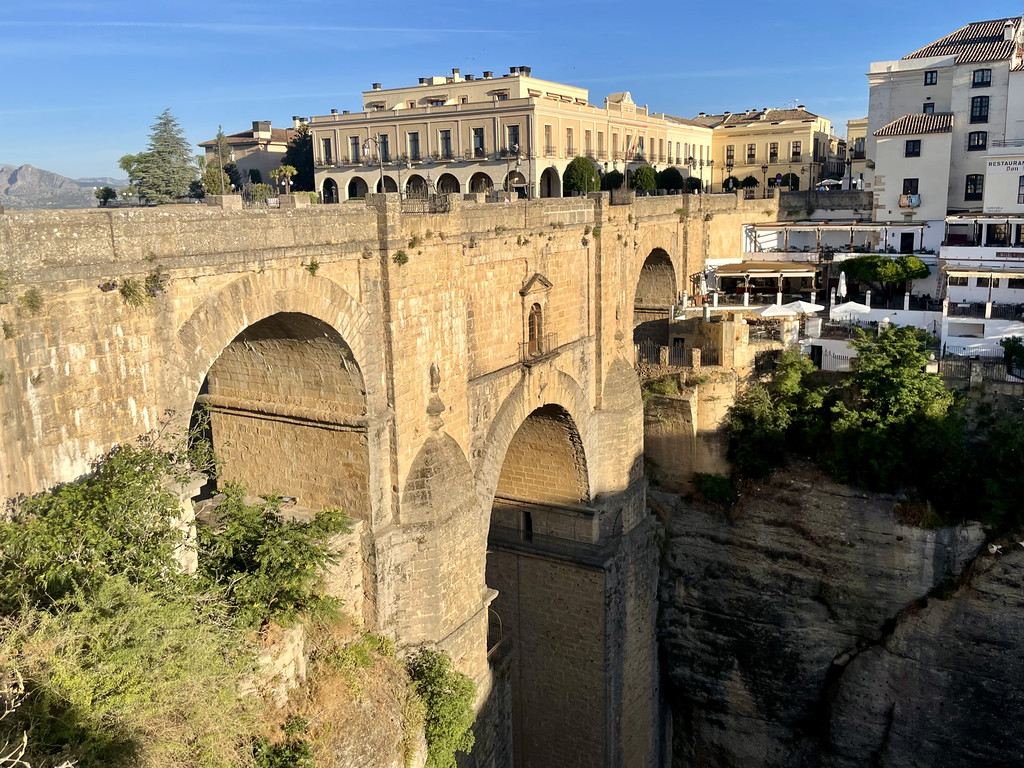
It’s impossible to miss Puente Nuevo. Staying four minutes away meant it was our first stop, and our last stop, each day. We walked across it, looked down from it, caught it from every neighboring viewpoint and in every kind of light—and that’s honestly the best way to experience it. Once we had it documented, we left it behind and descended into the old city.
The bridge is clearly noteworthy. But by the time we left, El Tajo gorge had impressed me the most—Puente Nuevo was just the structure that helped show the sheer scale of the gorge and the engineering it took to span it.
Walk Down Through Old Ronda to Puente Viejo
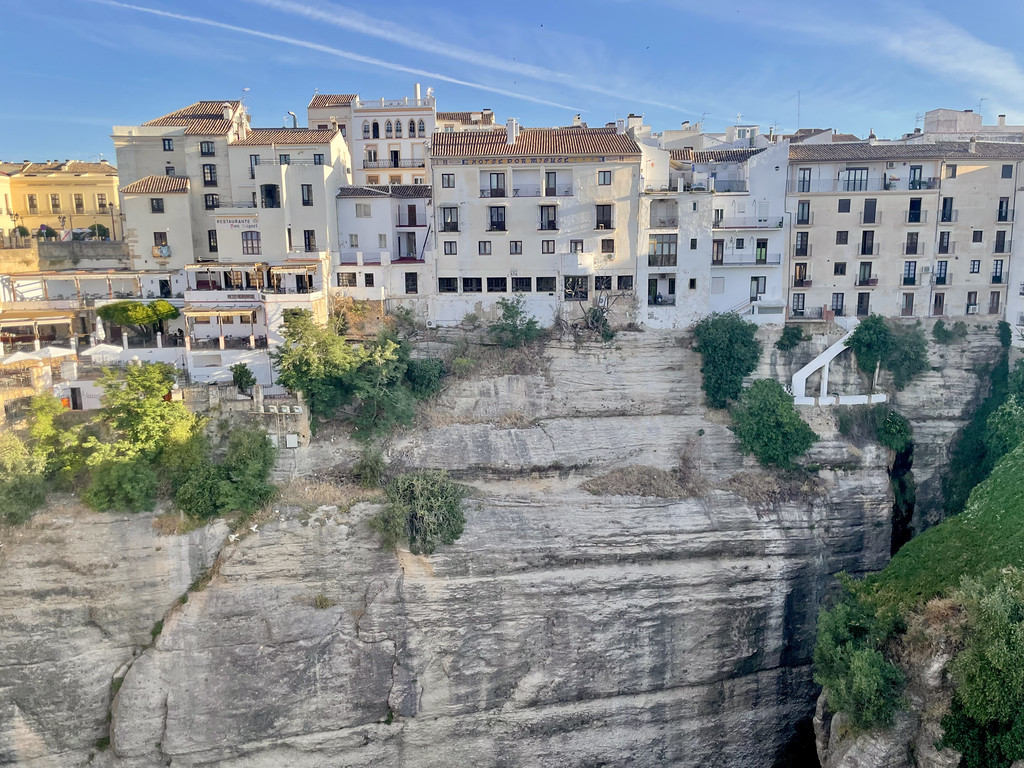
Descending from Puente Nuevo through Ronda is one of the most remarkable parts of visiting this city. The towering city-and-gorge walls crowd out more of the sun the closer you get to the Guadalevín River below.
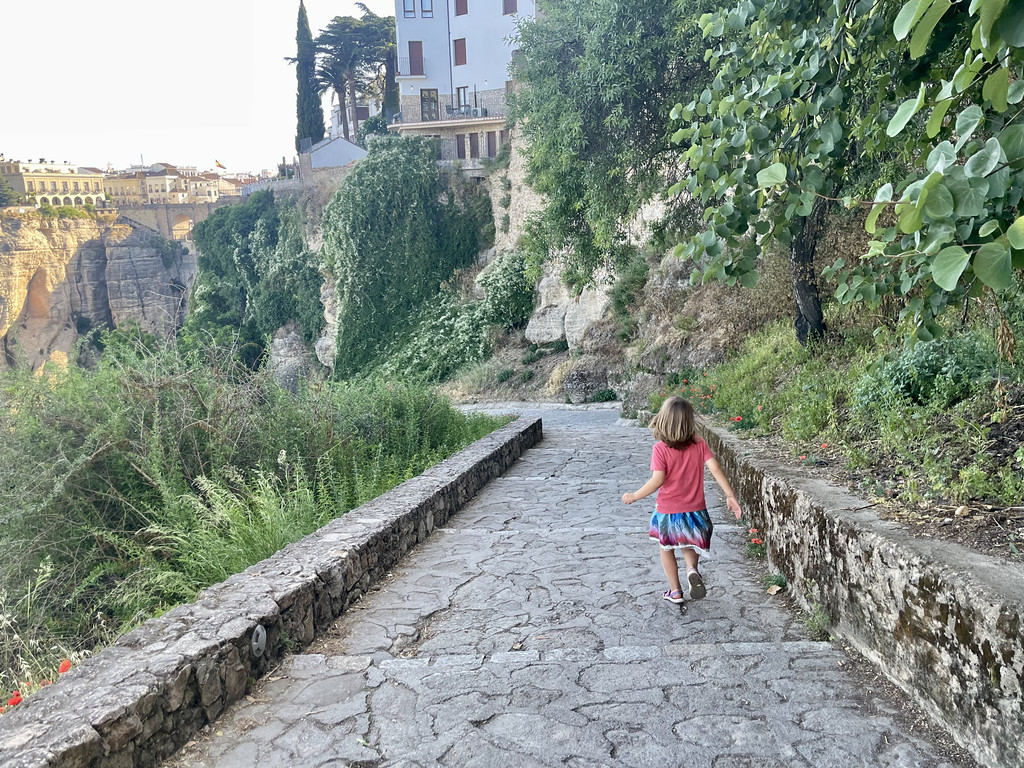
My kiddo followed Ronda’s streets and stairs downward at an unsafe speed, careening past old gates, darting under arches, and running his hand along stone walls as he flew over the cobbles and watched the city drop away.
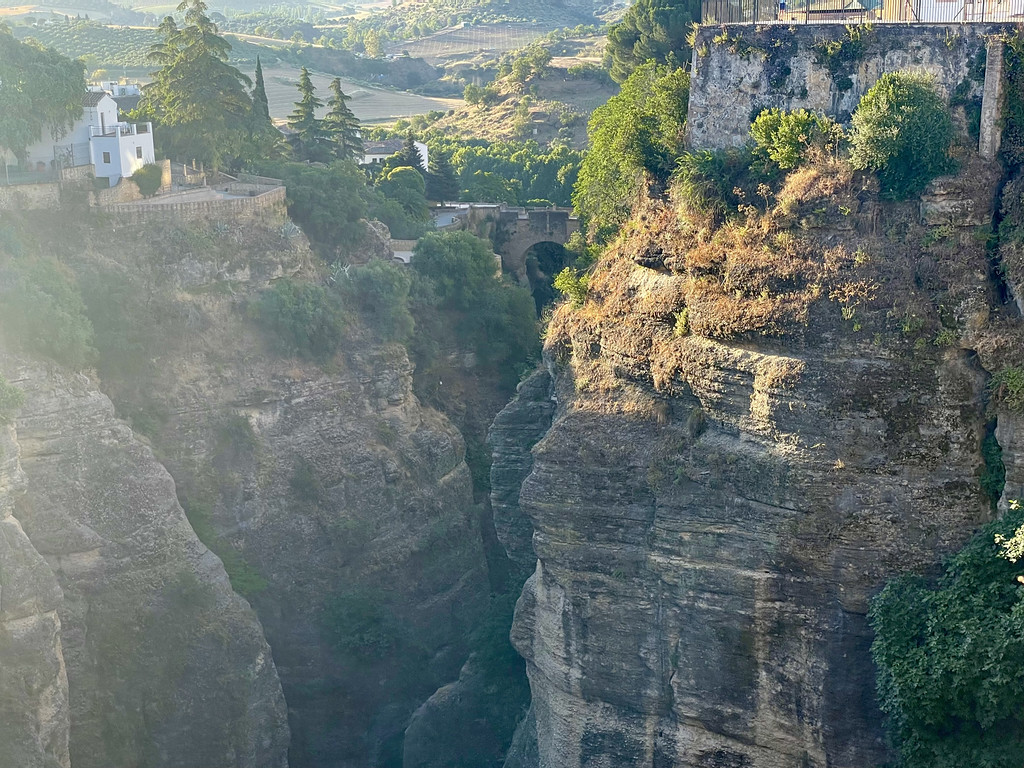
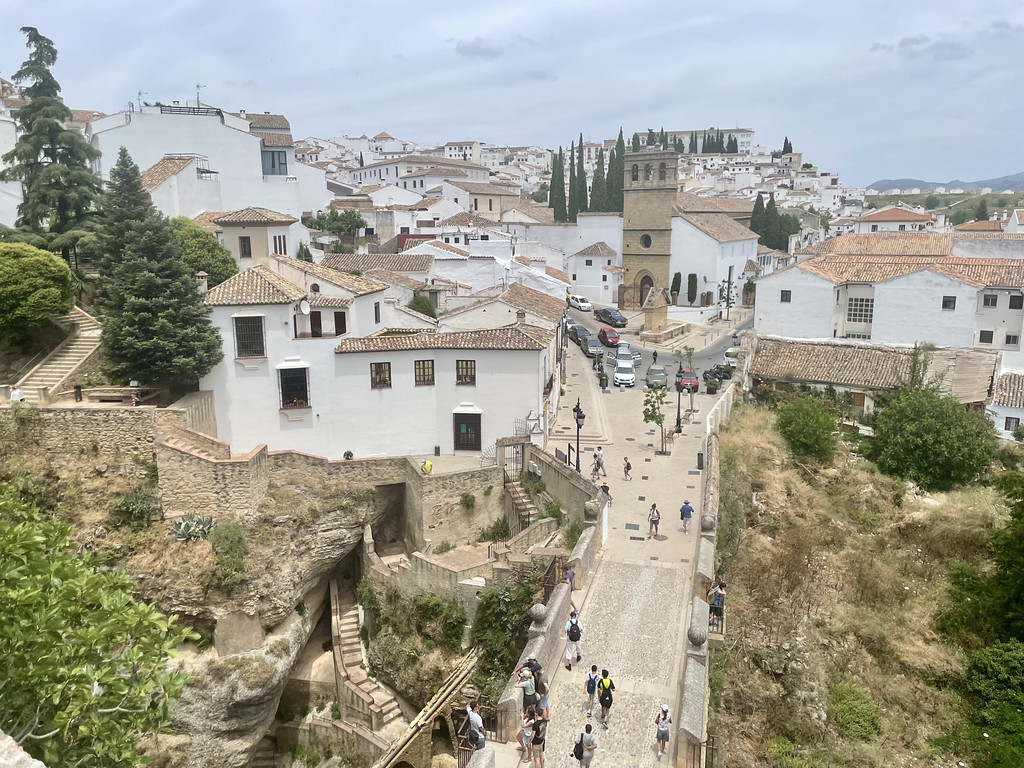
Puente Viejo was more interesting than I expected. It sits far lower than Puente Nuevo, and few people were jockeying for the same photo. Standing on it, you can easily see the entire city wrapping upwards around the gorge.
Visit the Arab Baths
The Baños Árabes de Ronda sit in this lower part of the city, close to Puente Viejo.
They’re atmospheric, and honestly better preserved than I expected. Entry was just €3.50 a head when we visited, and it was an easy way to pass 25 minutes inside. While there wasn’t a ton to captivate—the looping video barely caught his eye—he was intrigued enough by the air vents to ascend and descend multiple times so he could verify the holes we saw from above were the same ones he could see dappling light inside the baths.
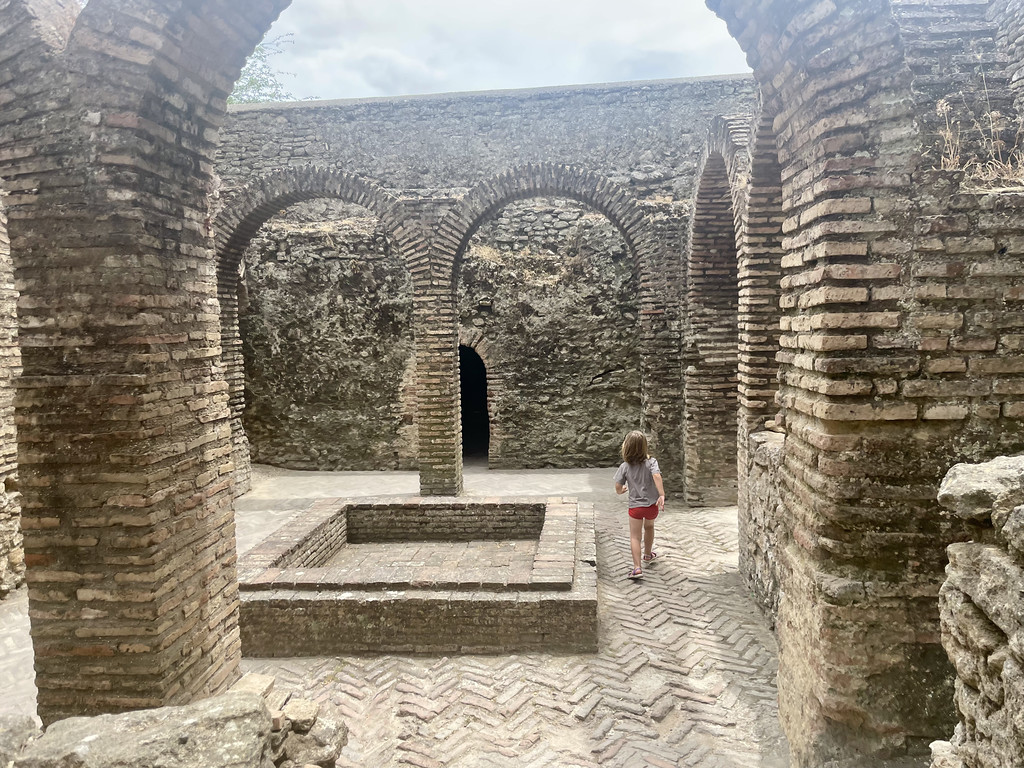
And during that back and forth, I caught enough of the video to be intrigued by the process of how the water entered the baths and its progression through the bathing rooms.
It’s also where we first heard water—an unseen trickle audible from the gardens outside the Baths—and he decided, with the total conviction only a four-year-old can manage, that we were close enough to just find it and get in. There was a boardwalk nearby that looked, for one very hopeful minute, like it might lead down toward the river. It didn’t. Someone had gated it shut. The idea of visiting the river had lodged itself in his head anyway, and it stuck there for the rest of the trip—more on that later.
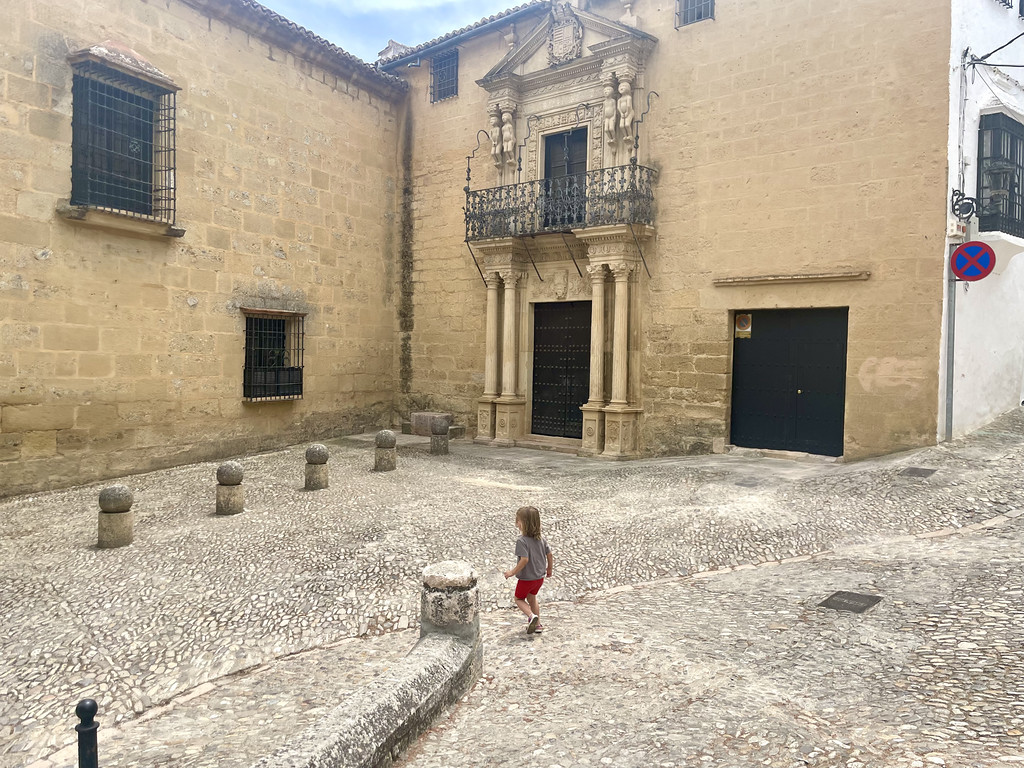
Puente Viejo, the old gates, and the Arab Baths were basically one experience for us, not three separate stops, and filled a good hour—longer with our unsuccessful detour to find nearby river access.
The Arab Baths also have clean bathrooms—hit those before you leave!
Stop for Wood-Fired Pizza at Il Forno a Legna
Pizza Friday is a weekly tradition in our house—one my son was acutely aware I’d broken the night before. Eight years into living here in Spain, I knew better than to expect much open before 8 p.m., his bedtime. Many of Ronda’s restaurants close between the Spanish late-lunch and dinner, so Friday night we’d solved it with a homemade quiche in the cooler instead—no negotiating restaurant hours with a hungry kid after the drive, but no pizza, either.
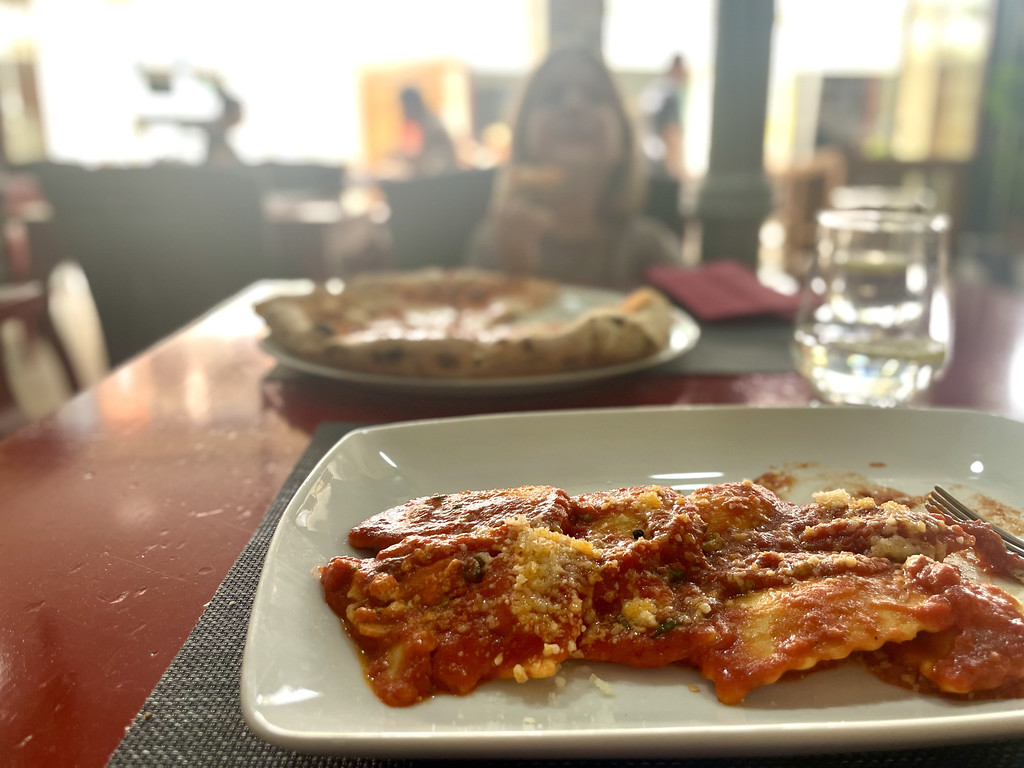
So pizza became lunch instead at Il Forno a Legna, a cozy spot just a couple of minutes from Puente Nuevo. The brick oven is right at the front, so we watched his pizza go in the oven. A hit. He got his mushroom pizza. I savored handmade pesto ravioli. We both left happy.
We ordered extra food, hauled the leftovers back to our Airbnb two streets over, and dinner was handled before we’d even headed back out.
Wake Up Early for a Completely Different Ronda
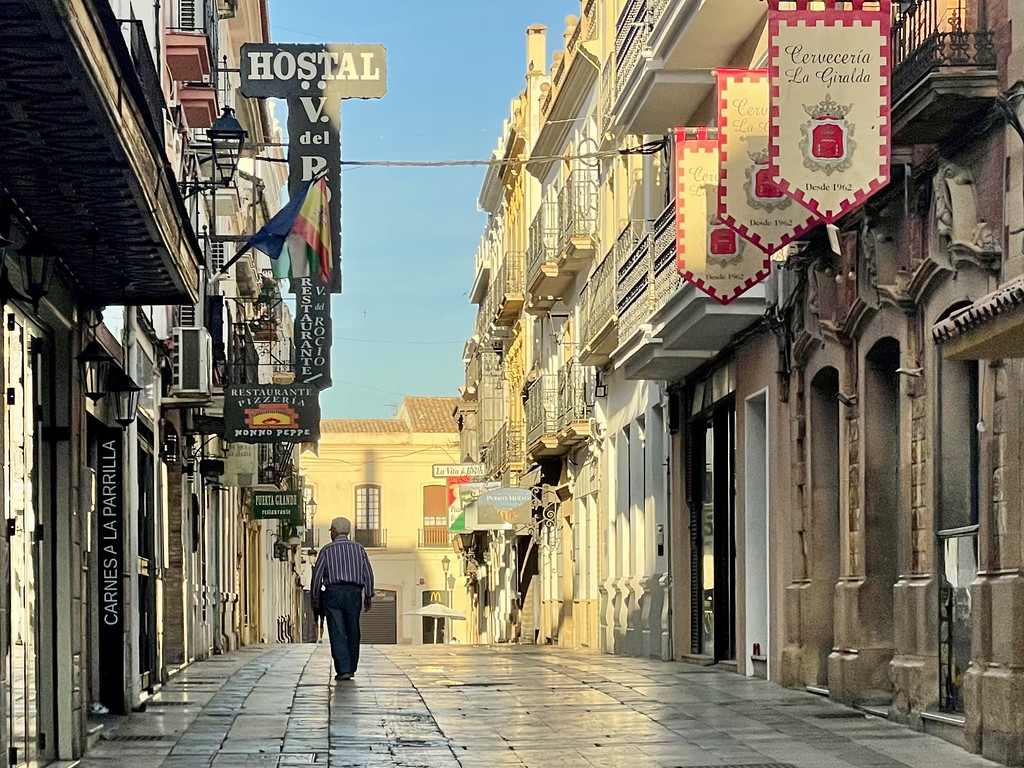
This is the part I’d most want to preserve if I planned the trip again.
Our second morning started early, because, well, life with a preschooler tends to start early whether a Spanish town is ready for us or not.
Ronda largely wasn’t.
Amaranta Café was one of the rare places serving breakfast early enough for us. For a while, we were the only visitors, so my son charmed the waitstaff with his extroverted litany of personal questions. As our food arrived, locals joined us at the bar for coffee and conversation while we lingered over our avocado-and-eggs-on-toast breakfast.
Outside, the tour buses had yet to descend on Ronda, so we headed for the playground and the Paseo de los Ingleses, which traces the edge of El Tajo.
Near the playground, I spotted an intricate colored alfombra already laid out across the pavement, no one around yet to explain why. Seeing the patterned carpet pulled me straight back to Semana Santa in Guatemala many years back.
Otherwise it was just locals—dog walkers, a few early runners. My kiddo, meanwhile, decided he needed to jump from every.single.bench we passed.
So, what could have been a quick walk took us a solid 20-plus minutes.
I didn’t mind.
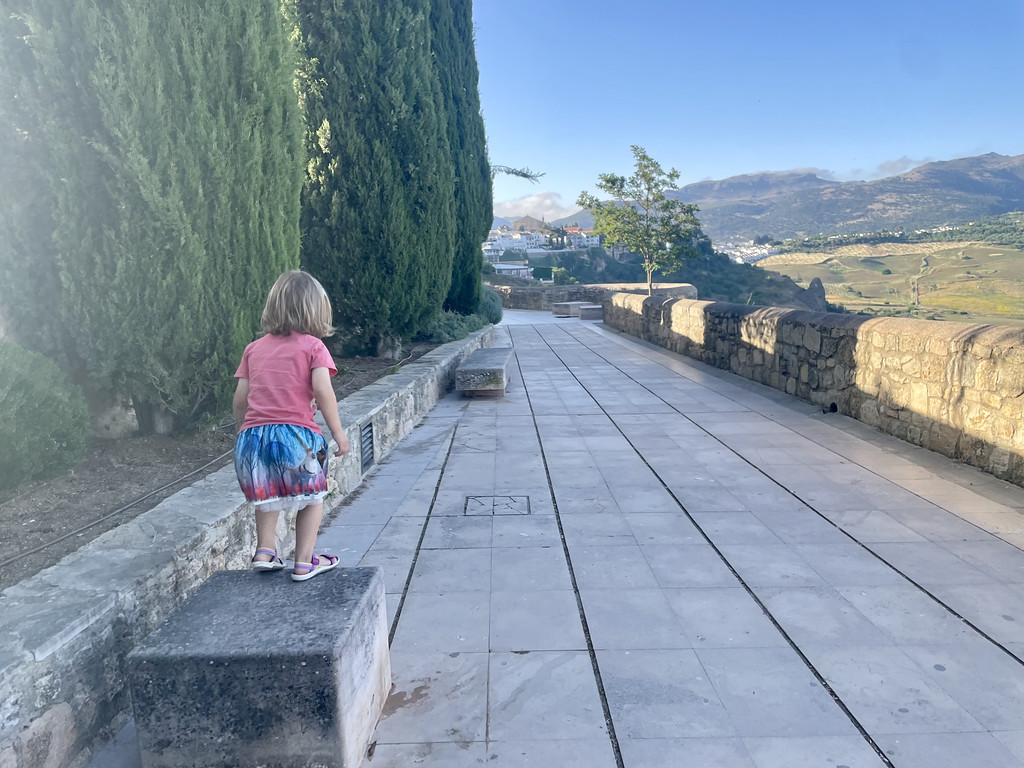
The pathway follows the edge of the gorge, opening repeatedly onto views across the landscape. From the playground, we followed another walkway leading away from Puente Nuevo. It narrowed and curved farther around the gorge until the views back toward Ronda disappeared and the landscape opened in front of us.
Eventually we’d wandered far enough. We turned around and slowly made our way back.
The whole walk, my kiddo pointed at every path and staircase visible across the gorge, convinced that each one would finally get him to the water’s edge. I kept pointing out that whatever path we walked down, we’d also have to walk back up. He was unmoved. He informed me—repeatedly—that this was going to be the best part of the trip. That we simply had to walk down into the gorge.
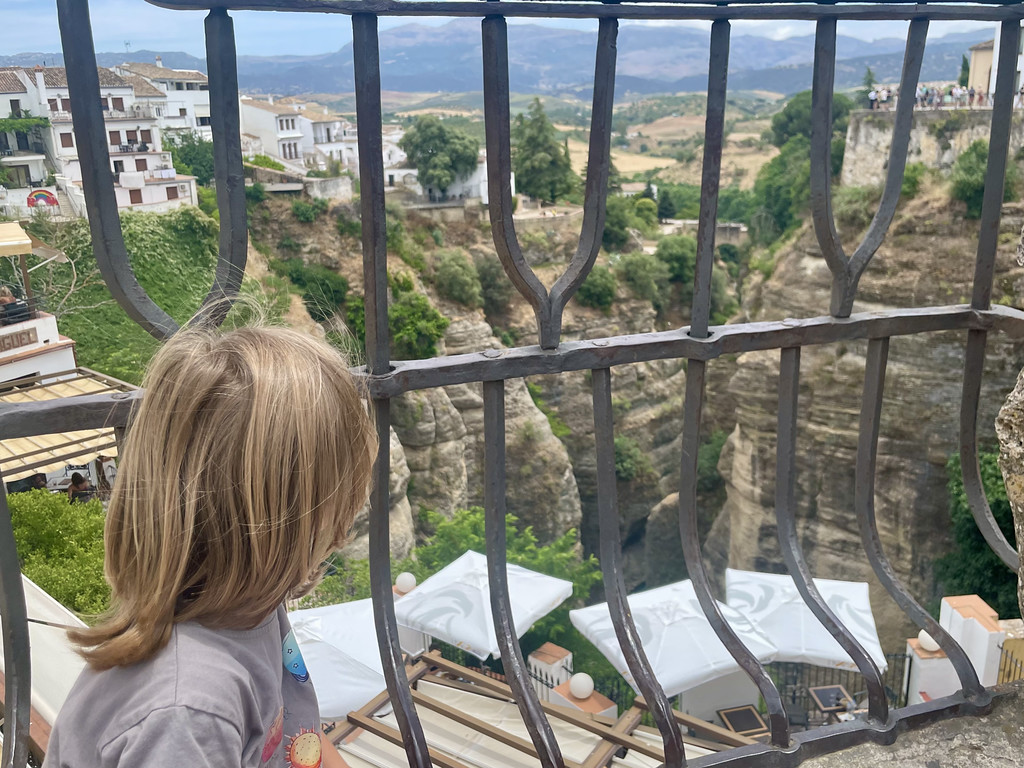
This is what staying overnight gave us that I wouldn’t have known to put on an itinerary beforehand. We weren’t seeing another attraction. We were just walking along the edge of the gorge while Ronda woke up.
Eventually we reached Puente Nuevo again. It was decision time: Do I allow my nearly 50 pound (22 kilo) four-year-old to hike down into the gorge, knowing there’s no way I could carry him back up—he’d have to walk?
He had been lobbying for this since the Arab Baths. Once he spotted the actual paths down from the opposite side of the gorge, that was it—he talked about nothing else all morning, and I’d run out of ways to say maybe.
So we crossed the bridge and finally did it.
Hiking Down Into El Tajo Gorge
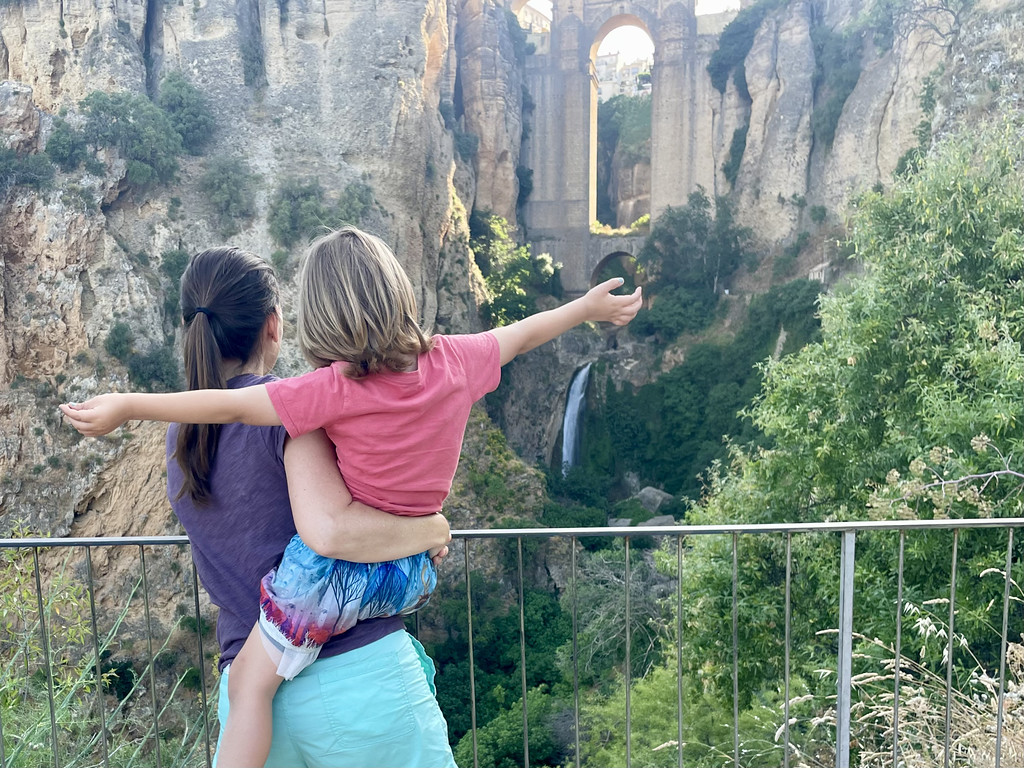
If your knees and shoes can handle it, getting below Puente Nuevo is the one thing I’d add to almost any Ronda day trip.
We went while the morning air was still cool, which mattered more than I expected going in. This stretch gets brutal, unshaded sun by afternoon, and I wouldn’t attempt it with a small kid at peak heat—steep, uneven, and blazing hot is a rough combination for little legs, no matter how badly they want the water.
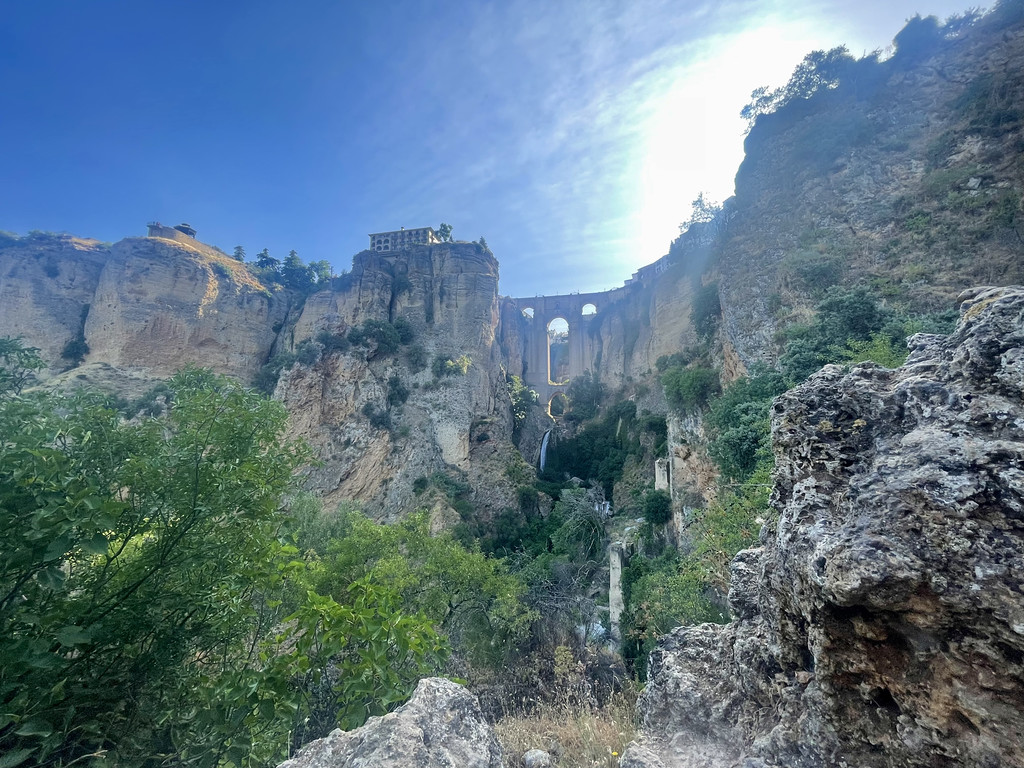
We passed the entrance to Ronda’s official Tajo gorge walk and kept going on the free path down. With only the first section of the official walk open when we visited, we didn’t find it compelling enough to choose over the route down toward Mirador La Hoya del Tajo and the lower Puente Nuevo viewpoints.
Parts of the walk were straightforward. Then we followed a much steeper rocky section that was one of those technically we’re still on a path, but this doesn’t feel much like a path anymore situations.
I had to pay close attention with a four-year-old. This was not remotely stroller territory, and it’s not a route I’d casually recommend for every young child.
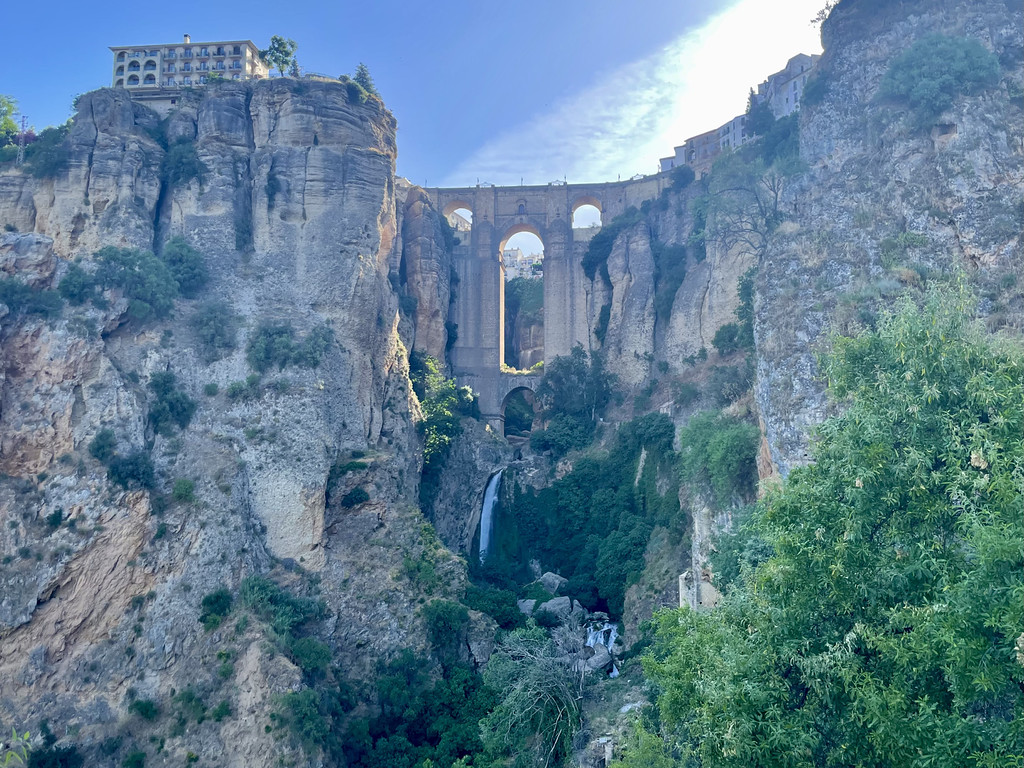
Mine, however, loved it.
The farther we descended, the more the perspective changed. Puente Nuevo rose above and across from us, with vegetation and a waterfall adding to the spectacle. Mirador La Hoya del Tajo also gives you distance that Puente Viejo doesn’t. The old bridge sits close to Puente Nuevo, on the opposite side of the gorge, so from there you’re looking up at Puente Nuevo rather than across at it.
We never reached the river.
He didn’t care nearly as much as I’d expected. We’d gone on a big adventure, and that was enough.
The Grandmother We Adopted Along the Way
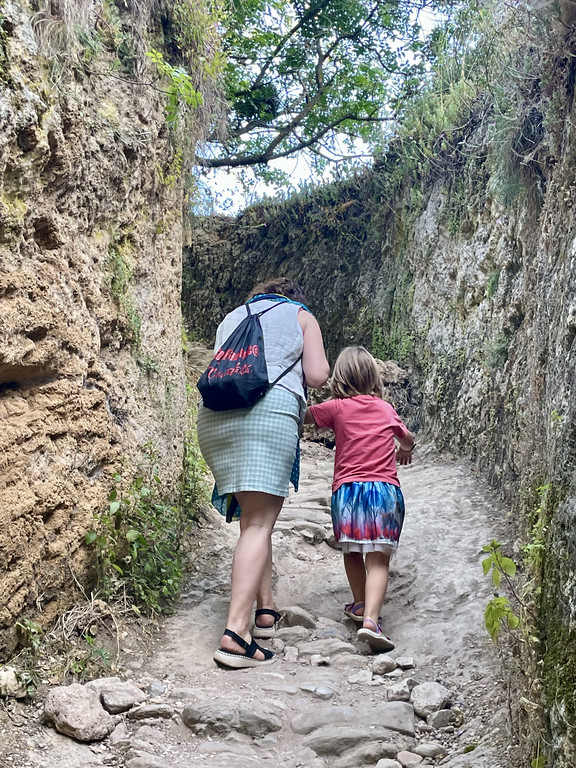
Somewhere on the descent we met Anna, a local grandmother originally from Valencia.
My son took to her almost immediately.
They spoke mostly in Spanish, but when we learned she spoke Valenciano, she even pulled out bits of long-dormant Catalan that he’d learned during his nursery-school years in Barcelona.
Before long, they were holding hands while they walked.
The climb back up was sweet—the two of them spent the whole climb alternating encouraging words when one would slow down. At least until his “tired” legs managed a manic burst of speed at the end, when Anna and I trudged side-by-side for the last five minutes.
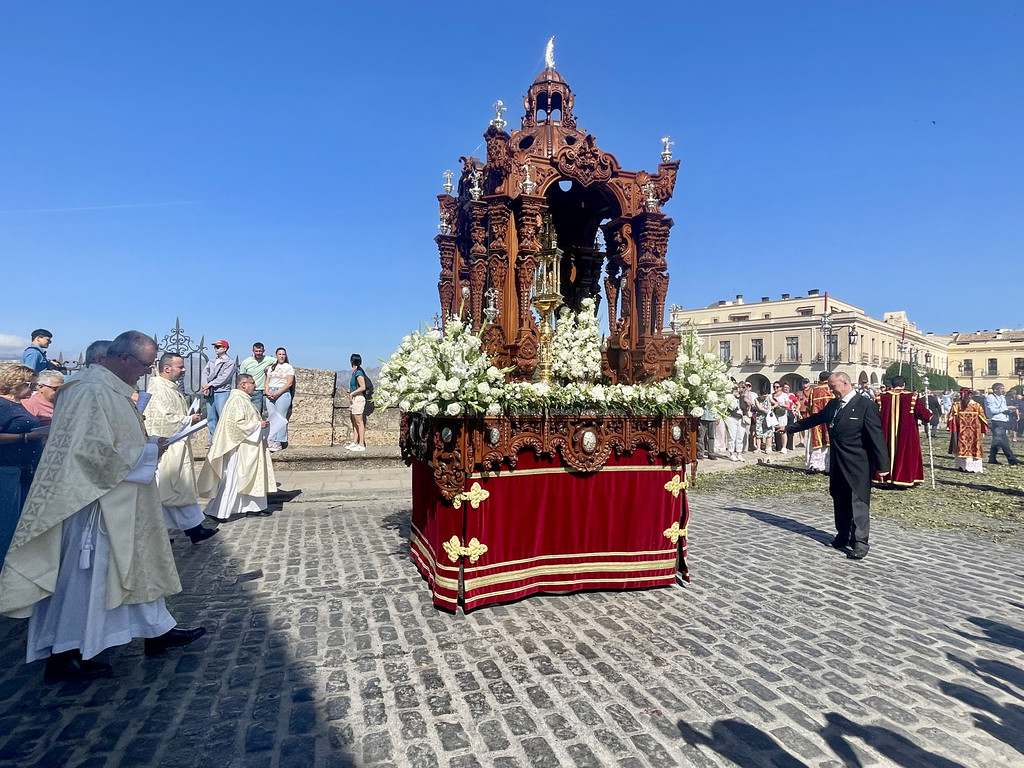
Just as we arrived back in town, Ronda’s Corpus Christi procession was unexpectedly setting out from a nearby church. We watched it leave with Anna—then she peeled off as the procession headed toward the alfombra from that morning. Numbers exchanged, we went our separate ways.
Couldn’t have planned any of it—or the repeated stops my kiddo insisted on making along the gorge trail to rescue beetles before someone stepped on them.
After Anna left, we found a machine that pressed souvenir coins. We didn’t have a coin for it—had to duck into a shop nearby and beg for change—but we got it working, pressed the one coin, and then it was time to check out and go.
Plan Your Trip to Ronda
Ronda With Kids: What I’d Know Before You Go
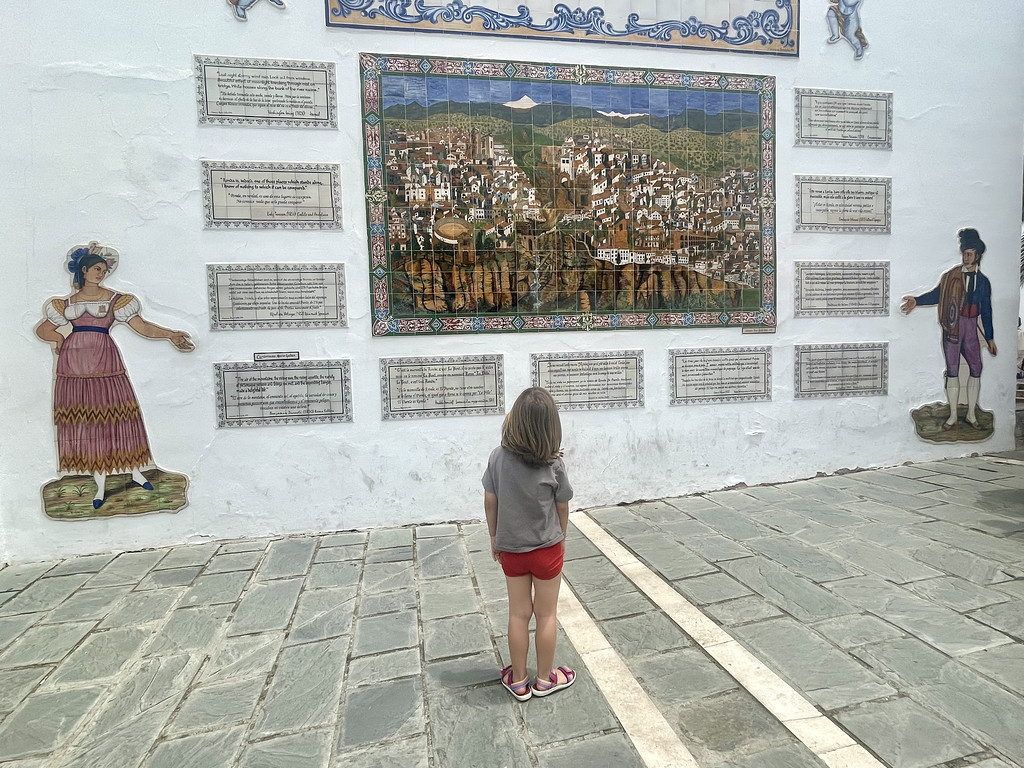
Ronda worked surprisingly well with a preschooler, but not because it’s packed with conventional children’s attractions. It’s just inherently interesting stuff—cliffs, bridges, staircases, a gorge you can stare into for as long as you want. His favorite parts, unsurprisingly, weren’t the ones any guidebook would list.
The biggest complication is the terrain. Ronda looks deceptively compact on a map—Puente Nuevo, Puente Viejo and the Arab Baths all look a few minutes apart—but the city’s built around a 100-meter gorge, and getting between them means an awful lot of steps. We never simply walked from Puente Nuevo to Puente Viejo; we descended through Ronda to reach it, then faced the climb back up on tired legs. I passed more than one set of parents with a kid riding their shoulders while they hauled a stroller up the uneven stairs.
If you’re visiting with a baby or toddler, a stroller will work for portions of the upper town, but it won’t survive the full itinerary we followed—a carrier gives you way more flexibility.
With younger kids, I’d resist the urge to pack the day with museums. Ronda itself supplied more than enough entertainment for us.
Getting to Ronda From the Costa del Sol
From our home in Benalmádena, Ronda is about a 90-minute drive, which makes it an easy day trip from the Costa del Sol.
We rented through DiscoverCars for this one. After eight years in Spain, this is our last summer as residents, and we’re finally doing some of the Andalucía day trips and weekend detours we never quite got around to as locals living in the Málaga area without a car.
Three ways to actually get here:
- Drive yourself, if you can. It’s what let us stay the night, wander at our own pace, and keep things flexible with a four-year-old. If you’re staying overnight with a car, prioritize accommodation with its own parking—I specifically chose our apartment partly because a spot was included, which meant we could arrive, park, and basically forget about the car until checkout. (A wrong-way ticket could happen anyway—ask me how I know: one missed turn into one of Ronda’s restricted-access areas amid the maze of narrow one-way streets, and a €50 fine found its way to the rental agency weeks later.)
- Organized day tour. Handles the driving and parking for you, which is genuinely appealing if that’s your main hesitation. You’re just on someone else’s schedule all day.
- Public transport. Direct buses from Málaga make Ronda entirely feasible without a car. From my home in Benalmádena, however, driving made a lot more sense for the trip we actually wanted—staying over, keeping things loose with a four-year-old, and ending with a quick stop in Setenil de las Bodegas.
How Long Should You Spend in Ronda?
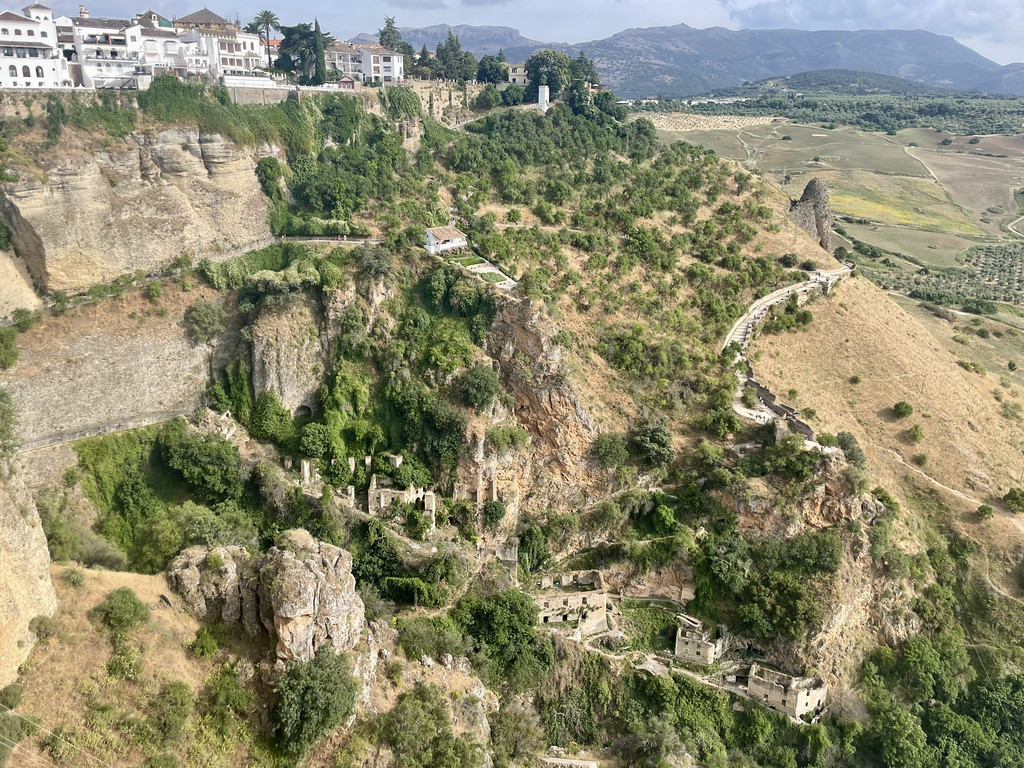
Ronda works perfectly well as a day trip. It really does. You hit Puente Nuevo, the old city, Puente Viejo, and the Arab Baths in a single full day—no problem. But you miss the quiet early morning hours before crowds show up, and the chance to hike the gorge without racing back to the car.
One night, if your schedule allows it? That’s my actual recommendation. You gain an evening—and, more importantly, that early morning before the day-trip buses roll in.
Two days work particularly well with younger kids or slower travel. We lost a significant chunk of our first day to my exhausted preschooler, yet we still caught the best of Ronda.
Ronda is absolutely worth visiting, even if you only have a day. But the best part wasn’t standing on Puente Nuevo or collecting viewpoints of it—it was walking down through old Ronda and eventually into El Tajo itself. The city clicked for me in those cool early morning hours when I absorbed the pace of life for those just going about their day. So, I’d happily take a day trip to Ronda—but, given the choice, I’d stay the night.